Monday, February 28, 2011

Xinca Garden

Way back in December, the Guatemalan government began a two month state of siege against narco traffickers in the Alta Verapaz region of Guatemala. Peace Corps evacuated all volunteers from that region. Lucky for me, Alta (as the volunteers there call it) is on the opposite side of the country from Casas Viejas and, double lucky for me, my friend Kamille who lives there decided to take refuge in my site. Kamille is an agriculture volunteer too, but her part of the program involves food security, ie family gardens, nutrition classes etc. While she waited out the unrest we went to work on a Cooperativa Xinca garden.

We chose the site of the garden. It wasn't up for debate because our plan
was two fold. First, clean up the back yard of the tienda which, unfortunately, served as a not-so clandestine trash dump, slash, town eye soar. The previous renters decided that leaving half burnt, quasi buried trash in a heaping pile in their yard was adequate disposal. The space was decrepit and Kamille, with her green thumb, was the remedy. After the clean up the second step was to beautify it with a garden. A project we hoped would instil a sense of pride in the property that was previously lacking and also motivate the Cooperative to better maintain the land. It worked. We spent a handful of afternoons preparing the land and I was amazed at how willingly the socios labored- even when the time they put into the garden was on top of their already stressful work days.
We cleared, cleaned, aerated and fertilized the land, built a fence and planted watermelon and cantaloupe seeds. We also took the opportunity to extend the project into a local school by teaching students the life cycle of a plant and then enlisting their help in planting our tomato seedlings in egg cartons. Once the seedlings are ready to transplant we are going to put them in hanging pots. A project that is still about three weeks away and the socios are already eager to get started. I have to constantly remind them that we can't plant the tomatos until the pilones are strong enough. They can't believe tomato plants can be hung and have already decided to try the technique at home too.

All in all, February was an extremely rewarding month. We witnessed a camaraderie among the cooperative members that had been lacking since the coop went into debt last year. It gave me great pleasure to see the socios come together and work diligently on something positive and productive and I hope their determination and good spirit continues through to other projects we are working on.

Last week Kamille got the word that the siege is over and it is safe for her to go back home to Coban. Yesterday, much to my chagrin, was her last day in Casas Viejas. Hopefully, she can come back in a month or so too a blooming garden full of juicy melons. Fingers crossed.

Monday, February 21, 2011

Esquipulas or Bust

Take a look at any Guatemalan tour book and you’ll find the section that covers the Pacific Coast is the thinnest of all regions. Sure, we’ve got the beaches of Monterrico and Autosafari Chapin but most of the write-ups are sugar coated and probably written just to meet some sort of publisher’s page quota. I once noticed that the “Rough Guide” has a blurb about Taxisco’s great leather goods. I’d never recommend to ever stop there. The only leather I’ve seen in that town is that on the boots of the drunks passed out in a puddle of their own urine in the gutter outside Bar Santa Rosa. That’s not “rough”, that’s disgraceful. If I wrote my own tour book to the Southern Pacific Coast it would start, “Most towns are best experienced through the window of your bus.” Instead of dotting the map with restaurants and hotels I’d star places where tourists could find clean restrooms.

Another good indicator that not many towns in the tour book are worth checking out is that Guatemalans avoid them at all cost. “Where then”, might you ask, “do people from your town vacation to?” The answer: “Esquipulas, of course”. Esquipulas isn’t near the Pacific, it’s in Chiquimula, half way to the Atlantic, but a trip there is a true Guatemalan’s excursion. How could it not be when the town is home to El Señor de Esquipulas, the famed Black Jesus that serves as a mecca for Latin American Catholics? It doesn’t hurt that there is shopping and a Pollo Campero there too.

After nearly 18 months in country I fancy myself part Chapina and therefore, jumped at the opportunity to join the Catholic church group in a day excursion to Esquipulas. The adventure started at 1:26 am when my neighbor Mirna yelled through my bedroom window, “Annalisa, Annalisa, ya es la hora (it’s time).” I jumped out of bed, opened the door and told her i’d be ready shortly. At 1:45 am I was outside of their house waiting with a handful of people for the chartered school bus that was to take all 60 or so excursionists. We were supposed to leave at 2:00 am, the bus arrived at 2:15 am, we waited for stragglers until our 3:00 am departure (hora Chapina). I’ve decided that the habitual tardiness that afflicts this country is a hinderance to it’s overall development. It breeds complacency, a lack of motivation, responsibility etc, etc. but that is another blogpost.

I half-slept during the 4-hour bus ride to our destination. I shared a seat with my neighbors Milbia (age 26) and her kids Benicio (age 2) and Lesli (age 4). When we arrived we ate a packed breakfast on the bus. I brought an apple, my neighbors had chicken salad sandwiches. I took interest in analyzing how the different generations ate their sandwiches. Luis (age 8) spread the chicken salad between two slices of bread and ate it how most Americans would eat a typical sandwich. Mirna, his mom, put the filling on the bread and folded it in half, like a taco. Regina, his grandmother, put the chicken salad in a bowl and used the bread as an edible utensil to scoop it up. Full from breakfast, we set out to see Jesus.

El Señor can be found in the huge white Catholic church in the center of town. At 7:30 am there was already a long line of devotees snaking out of the church along the perimeter and into the plaza in front. During our winding stop-and-go pilgrimage to see El Señor I was tricked by two fake-out Jesus statues. The first was a black Jesus housed in a tent to the left of the church. Everyone was lighting candles in front of him so I thought he was the one. Turned out to just be a replica. The second occurred when we finally entered into the side of the church and came upon another Jesus. The woman I was standing next to grabbed my arm and said, “Nuestro Señor, Jesus Cristo.” She said it so passionately that I thought the encased statue of christ crawling was the one. I had already taken a picture when I realized he was painted white and couldn’t possibly be the black Jesus. Third time’s a charm. Shortly thereafter we curved around the white Jesus, walked up a small ramp and were face to profile with the real El Señor de Esquipulas. We circled around the encased statue directly behind the church pulpit. As we made the loop we overlooked the mass that was taking place in the church. We then backed down the ramp- so as to not “dar la espalda” give the back to El Señor. Our pilgrimage was complete.

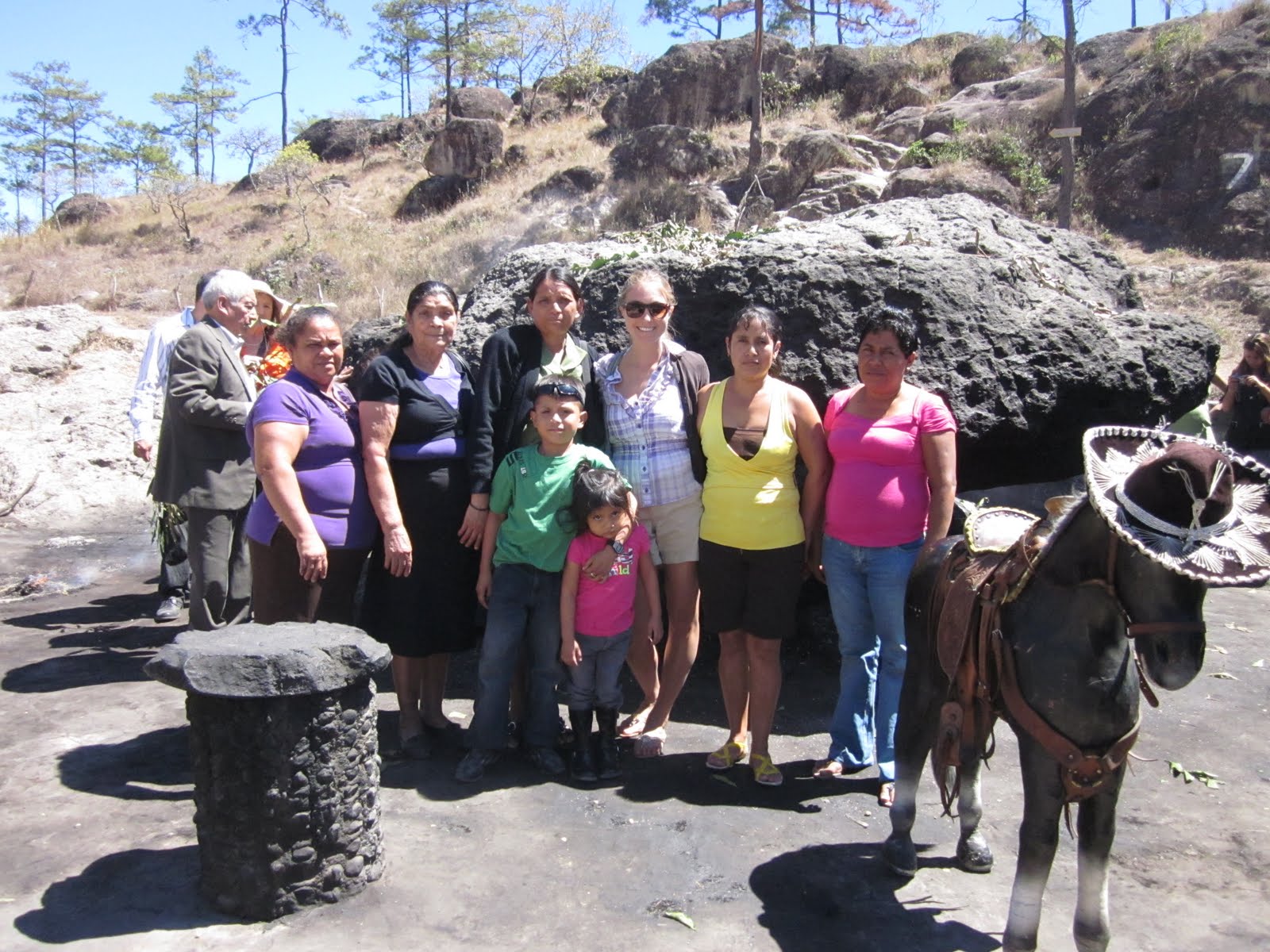
Outside of the church we decided to take a tuk-tuk ride la Piedra de Los Compadres. The explanation sheet I bought for Q1 states that the site “consists of two enormous rocks that throughout time and earthquakes, one has stayed on top of the other keeping a mysterious and strange equilibrium... with three or four points of contact.” As the legend goes, 300 years ago the
rocks encased the bodies of two compadres, a man and a woman, making love while on their journey to Esquipulas. I also paid another Q1 to buy a leafy branch and candle. We walked around the rock and hit it with the branch. Everyone I was with kept crouching down in between the two rocks looking for the “breasts” but I couldn’t discern anything that looked like a woman’s chest. the woman who sold us the branch said to do it 7 times but we only did it twice. When I asked my accomplice why we didn’t finish the seven she simply said, “Two is enough.” Then I lit the candle and placed it under the top rock as all the others had done. I think I was supposed to make a wish but was too caught up in the moment and forgot.

Pollo Campero was our third destination. Then we did some shopping in the market and were back on the bus by 3:30 pm. We were supposed to leave at 4 pm but waited for stragglers until our 4:30 pm departure. As we pulled out of the parking lot I could already feel my back begin to ache and my legs begin to cramp. Then I looked over to the seat next to me at an 80-year-old woman with a cane shaking feebly and wondered, “if I am pained by the discomfort of this journey, what does she feel like right now?” On the 4-hour ride back home I reveled in my day of Guatemalan integration. I had paid tribute to El Señor, ate Pollo Campero, shopped for dulces with the ladies, got my fortune told by little birds and even contemplated asking the bus driver to make me a copy of the CD he was blasting. At 9:30 pm we arrived in Casas Viejas and as I caught myself admiring the bus ayudante’s bulging bicep muscles I realized my integration had gone too far. It was time for bed.

Sunday, January 30, 2011

Amigas

The friendships that I have formed in Casas Viejas have taken many shapes. I have friends, like Nancy, who laugh at my jokes, friends like Milbia, who I can ask to water my plants when I’m away, and friends like Marena, who know how I like my shucos (no mayo, extra jalapeños). These friends have given me the gift of belonging for which I will forever be indebted. Yet, making friends in Guatemala is nothing like making friends in The United States. Here my friends and I share the mutual understanding that there will always be language and cultural barriers between us. For over a year I have battled with the truth that most of my friendships in site are quite superficial. Not to say that all of my relationships in town are insignificant, quite the contrary, it’s just taken me a year to realize which friendships are genuine and begin to appreciate those that are.

I have been accustomed to being the instigator of most of my friendships as well as bearing the brunt of the work to maintain the relationships. It must be noted, however, that Guatemala is a very family centric culture and, being an outsider, people don’t really know how to involve me in their daily lives. Hanging out with the gringa doesn’t generally make their daily the to-do list (so sad, if only they knew what they were missing out on). Surprisingly though, recently I found out that is not always the case.

I was finishing cleaning my house a couple Sundays ago when my friend Tanya drove up on her bike. Every once in a while she’ll stop by to sell me fresh shrimp but it is rare that I see her more than a couple times a month. I invited her in and we sat at my table and began to chat. She asked me if she looked pale or sickly. She did look a bit fatigued so I asked her if she was ill. Then she told me that she had just spent the past four days, affirming with her fingers as she counted, “Wednesday, Thursday, Friday, Saturday. Yes, four days, sick in bed.” She said her head felt like it was going to explode, her bones ached and she was freezing (mind you it is a “chilly” 95 degrees here) but couldn’t stop sweating. “Oh my, it sounds like you had dengue!” I replied. She told me that she was so sickly and weak that her two daughters, Melissa and Jasmine, cried by her bed and asked her if she was going to die. She said, “I was miserable but all I could think was, ‘it's better that I am sick than one of them.’ Finally, today I started feeling better. I feel heat again, which is a good thing. This is the first time that I felt healthy enough to leave my house.”

It dawned on me that Tanya had just escaped the jaws of death and the first thing she decided to do was visit me. Tanya needed to get out, breathe a breath of fresh air, rejuvenate her spirits and she came to my house to do it. I was flattered. I have always felt like I need my Guatemalan friends more than they need me. This was the first instance in which the roles were reversed. We spent a good portion of the morning catching up and then she vowed to come back later in the week with Melissa and Jasmine. I sent her home with a chocolate bar for the girls.

She kept her promise and a few days later the girls came over. We looked up dresses online together (I was bridesmaid dress shopping) and Jasmine pointed to each dress we looked at and said, “A mi me gusta esto” (I like this one). We swayed in my hammocks. Jasmine played in my baby pila and Melissa flipped through my photo album. It was pleasant to have visitors over who were content just passing time with me. They left after a couple of hours, Melissa toting a photo of my family. She had asked me, “me regala?” (Will you gift it to me?)

While most of my friends are busy with their daily routines, I am especially thankful that Tanya and her daughters think to make me a part of theirs. What gives me even more delight is being able to share my house, my hammocks, my chocolate with them. Unlike many of my friends in town, Tanya comes from the poorest part of Casas Viejas. She lives in a one room house with dirt floors, cooks over a wooden fire and has no refrigerator. Their presence at my house makes my life more pleasant and I am happy to share my space with them to return the favor.

Tayna's daughters, especially Melissa, are the reason why Tawnya and I are friends. I had just arrived in Casas Viejas and hadn't even formally met her daughters (they had just seen me in passing at the Tienda), when they begged their mom to invite me to their birthday party. I gladly attended, took pictures and swung at the pinata with the rest of the kids. Ever since, Melissa runs to me when she sees me around town and gives me the most amazing greetings - hugs and smiles that make me feel like the most important person in the world. Once Tanya told me that Melissa remembered that when I first came to Casas Viejas I told her that I’d be here for two Christmases and that after this past Christmas she cried because she thought that I was leaving. It makes me wonder what I did to deserve such adoration. To be honest, I did nothing. I don't want to believe that they run to me in the street just because I have light skin and blond hair but, I know that is at least part of the reason. The least I can do is try to rightfully earn their fondness. I'm still working on it.

This past Thursday Tanya showed up at my house again, this time she was selling shrimp that her husband had caught. I bought the shrimp and invited her in. She said she had to run an errand and then would come back with Jasmine. One hour later all of us were hanging out again. When noon came I offered to make them lunch and whipped up a dish with the shrimp. It is pleasant to have company over. Company I can be myself around. Effortless company.

When they left, Tanya said they’d be back, next time with milk and bananas to make liquados (milkshakes). I told them I’d supply the chocolate.

Wednesday, January 26, 2011

A Musical Education

I'm being lazy this week so instead of writing a blog I am going to publish an email I sent to my friend Kamille way back in October.

::::::::::::::

Ever since my parents brought me my guitar from The States I've been wanting to happen upon a Latin guitar virtuoso to inspire me with his magical strumming fingers and teach me lovely light-hearted Spanish tunes like "la bamba" or "cielito lindo." My hunt has been all but fruitful.

My first hopeful encounter with a potential maestro was way back in May, I think. My next door neighbor, after over hearing me toil clumsily on my guitar, beckoned me to his stoop to tocar la guitara with him. I was stoked. He is old and his family is catholic so I figured he'd know some good classic tunes. But to my chagrin, about two minutes into the session I discovered he was tone deaf and had sluggish fingers. Generous-hearted and well meaning he was, but my maestro he was not. So it was back to stumbling through chord progressions on my own.

Until tonight.

I whipped out la guitara this evening for a quick after dinner sesh. Sitting in my green plastic chair under a dangling light bulb in the backyard I began warming up with a little "Knocking on Heaven's Door" (the second of the two tunes in my huge repertoire) After the song I was shuffling through my sheet papers when I heard a, "ssshhht, shhhhht, shhhhht" coming from my neighbors house (different neighbors than before). I turned my head only to find their entire family lined up at the fence listening to my awful attempt at Bob Dylan. The father figure (I still don't know the brother/sister/mother/father/son make-up of the family) asked me what "notes" I know. I told him that I've mainly been learning chords and asked him if he played the guitar. He replied, "yes". Enter second potential virtuoso. Eager to see what tricks he had in his bag I handed my guitar over the fence and begged him to play a song. The family insisted I come over to the house and sit and listen. I obliged, as any respectable neighbor would do. I walked through their house to their backyard and they pulled up a chair for me. The father figure then started tuning my guitar, teaching as he went along how to tune by ear. "Yes, finally, someone that can play the guitar!" I'm thinking to myself. Still getting used to the sound and feel of the guitar he started playing some familiar sounding chords. I couldn't put my finger on where I had heard them before but all was good, i was getting into the music. Then he started up with his first song and it hit me like a load of bricks. Those familiar chords, paired with that familiar plucking rhythm combined with those all too familiar lyrics- this was loudspeaker worthy evangelical church music. It abruptly and painfully dawned on me that I had just invited myself to a personal evangelical sing-song session. I began to whimper internally.

I have nothing against Evangelicals or Evangelical music, it's just that I sometimes feel inundated by their preaching. I have the chance to absorb the religion at least twice a day. I wake up to a loudspeaker sermon at 6:30am and eat dinner to a loudspeaker culto at 7pm. I just wasn't in the mood to sit through "Lavare, lavare" "Glorious Dios" "El Señor" songs at such close range. But, I did. The family and kids clapped and sang along while I sat there with a forced grin on my face. I was calculating in my head how many songs I'd have to bare before I could politely excuse myself for the evening when something strange began happening to me. The redundant plucking of the overused chords and creepy lyrics put me into this crazy trance. I felt like I was being transported into the sepia tone world of "There Will Be Blood". I realized this is why all those people go crazy at the church down the street and start screaming and babbling in tongues. This music is possessing. I had to get the heck out of there before it drug me to the dark side. As soon as the song was over I said, "that was beautiful, you'll have to teach me it sometime." Grabbed my guitar and hurried home. Safe on my side of the fence I poured myself a glass of boxed wine (strictly prohibited by Evangelicals) to wash away the culto-ness of the evening's events. As i sipped the drink of the gods, I thought to myself, "this tastes amazing, leave it to vino to save me." Then, reciting what wise Don Edgar once told me, I said to myself, "and hell, if it's the devil, then let it take me."

Wednesday, January 12, 2011

Angel from Los Angeles

While in Casas Viejas, I have witnessed weddings, baby showers (called baby showers in Guatemala), birthdays and graduations. It was just a matter of time before I’d attend a funeral.

My first day back at the tienda after the new year, I walked into the store and found Adan and Miselly already at work counting the register. Nancy had quit after Veronica ostracized her for talking to her baby’s daddy. Miselly is her replacement. Employee number six in so many months. I greeted them, asking how their holiday was and Adan said, “For us it was fine, thank God.” I thought it was peculiar that he stressed the “For us” part. The reasoning became clear when moments later he filled the silence with, “Alfonso is not going to be working with us for some time, he lost a son.”

Alfonso’s son, who everyone called Junior, had been living and working in The United States for 22 years when he suddenly fell ill and died in a hospital in Los Angeles. He was about 40 years old and survived by a wife and eight children. All week everyone was commenting about when “he” would arrive. Junior’s remains were being sent down to Guatemala so he could receive a proper burial in the Casas Viejas cemetery. The casket arrived Monday, the vela (candlelight vigil) was planned for that very evening and the burial was to take place on Tuesday.

Tuesday morning as I was doing some work at home Loyda came by my house and yelled for me through the chain link gate at the side of my house. “Annalisa” she shouted to me in a raspy voice (she’s been nursing a mean cold/flu for the past week). I ran to the gate to meet her. “I can’t come to cook today, the burial is at 3pm” she said while covering her mouth with a little towel. “That’s not a problem. I’m going to postpone the cooking class.” I responded. I was already prepared to do this if the funeral was in the afternoon. I then asked if she and Adan could come by my house before they headed to Don Alfonso’s so I could accompany them to the funeral. She said she’d be by at 1:30 or 2:00.

Don Alfonso lives about a kilometer outside of town in a small cement whitewashed house. His living space is modest with an outdoor kitchen and an outhouse teetering on the sloped bank of a small stream that cuts through his land. We pulled up to his house in Adan’s pick up truck loaded with townspeople we had picked up along the five minute drive. Tents had been set up surrounding the thatch roof rancho under which, in better times, hammocks hang, but now housed the flower adorned pearly white casket. There was little refuge from the pounding sun and mourners had strategically placed their plastic chairs to optimize the little shade that was available. As I took a seat under the protection of a tall bush I noticed three electric fans were airing the coffin.

The heat had also drawn enterprising granisada (snowcone) vendors to cool the crowd with their Q3 icy treats. One of the granisaderas is a surprisingly white, nearly mute, kind-hearted woman named Marta who I have been known to hunt down on particularly scorching afternoons. We share a bond over our mutual inability to understand everything that people are saying around us. On Tuesday Marta’s ever present smiley face was enhanced by colorful make-up. I could see from ten yards away that she suffered from an over application of blush. But, I supose one must try extra hard to show respect for the deceased, especially when profiting from their untimely death. Both Loyda’s sons ran over to Marta with change in hand as soon as we sat down. On any other occasion I probably would have joined them (I have become addicted to the sweet tamarindo jam that is placed on top of granisadas) but I felt it probably wasn’t appropriate for a grown woman to slurp a snowcone during a funeral procession.

I spotted Alfonso near the entrance to his house. It was the first time I had seen him without his signature white cowboy hat. Its absence aged his forlorn face.

As I waited for the ceremony to start I soaked in the surroundings. A limping pig was sauntering around the pila and outhouse and a overheard a little boy peeing behind me in the bushes. Its amazing how the sound of pee hitting a solid doesn’t make me flinch- I’ve become so accustomed to boys and men alike making impromptu urinals wherever they feel fit.

Don Alfonso’s granddaughter was filming the crowd and I couldn’t help but wonder under what circumstance would anyone want to watch that video.

About thirty minutes passed and the priest presented himself and began to talk. I noticed that he mainly addressed the Catholics in the audience who were gathered closest to his makeshift podium. The Evangelicals were scattered around the periphery. He did, however, start his eulogy by saying that he loved everyone, Catholics and Evangelicas alike because, “We are all God’s children.”

The tribute didn’t last long and when the priest asked if anyone would like to say a few words, not one person stood up. After a few songs lead by Oscar Ruben’s mom, Julietta, the casket was lifted and the funeral procession began. As I stated earlier, Alfonso’s home is quite a ways out of town so the march to the cemetery ended up taking about an hour to complete. There were numerous stops to allow the rotating pallbearers to exchange duties. I had secured a black umbrella from the funeral coordinators and thus, kept the beating sun off my head as we slowly progressed down the town’s main street.

When we arrived at the cemetery a crowd already surrounded the burial site. Mourners sat and stood on nearby cement graves and the pallbearers carried the casket and placed it in front of the newly cemented block that was to be Junior’s final resting place. A well-respected man of town who I know only as Profe (professor), climbed atop the gray grave and addressed the grievers. I was standing behind the grave and stared at his back while he gave his impassioned panegyric over the coffin.

At one point during the praise Profe said, “Junior had left Guatemala in search of a better life in the place that we call the land of dreams.” It was the first time I had heard anyone in my town talk about the United States while not addressing me. It gave me a bit of an out-of-body experience, like I was eavesdropping on a conversation that I shouldn’t be listening to. I got a little uncomfortable. Profe wasn’t saying anything negative about the country, but it was awkward hearing it discussed in such a solemn setting. I was reminded that as a Peace Corps volunteer, I represent the United States and in that role I felt mildly guilty for being from the country that lured Alfonso’s son away from his homeland. I was probably the only one present who had these sentiments but regardless, they still hung heavy on my heart.

After Profe gave his final words the coffin was slid into the block and cemented over. I could hear Junior’s mother wail uncontrollably as I followed the crowd out of the cemetery with tears in my eyes.

Saturday, January 8, 2011

Baile, baile.

I’m sure you have all, as I have, finished nurturing your holiday goma (hangover). That exhausted, yet satisfied feeling that follows the year’s end frenzy of festivities. My recovery took a record-long five days. I blame the lengthy recuperation on my necessity to process all that I experienced in 2010. It was a whirlwind year.

In work, progress was slow, but time was well spent. I smiled more and laughed more (even if I didn’t understand all the jokes).

In experience, I learned to listen. Really listen. It took patience to silence the interjecting voice in my head that would talk over whoever I was conversing with. I’ve stopped always thinking about what I want to say next, and instead, have started focusing on what other people are saying.

In friends and family, I expanded both. Made new lifelong friends while cultivating a deeper appreciation for the people already in my life.

In life, I have been humbled. Spending some of my richest moments with some of the poorest people in the world.

All of this reflection led nicely into some forethought.

Yesterday, I picked up the Diario (newspaper) and read my horoscope (the only thing worth reading in that paper) and it told me that this year was a year of new beginnings for Virgos. It specifically said, “pick up and move.” Since I have no intention of leaving Guatemala just yet, I decided to interpret “move” loosely as “dance.” I chose this interpretation because recently I realized just how much I love dancing.

On two occasions I was gifted the opportunity to dance with my family this holiday season. My mom + dad + Nate + Colleen - Danica (we missed you Dani) came down to visit Guatemala for 10 days between Christmas and New Years. On the day they arrived, Noche Buena (Christmas Eve), Casas Viejas had a town baile (dance). I usually shy away from the town dances after realizing it is hard to make up good excuses as to why I can’t dance with sweaty drunk guys I don’t know ("I'm tired" doesn't work), and even harder to make up excuses as to why I can’t dance with guys toting pistols. But, on Christmas Eve, I was excited to enter the baile. I found protection in our little gringo bubble as we shuffled into the brick wall lined basketball court in the center of town. The scene was what I was used to. Clean shaven guys in Holister tees and girls in skinny jeans and bright colored tops with matching sparkly eyeshadow crowded the court. About 25 couples danced under the night sky, swerving in and out of the black stands that propped up the strobing club lights. Another 100 people were standing around the edge of the court spectating while making mental notes as to who was dancing with whom. And finally, a handful of kids were zigzagging in and out of dancers and onlookers while waiving firecrackers. Our group of six (Fernando accompanied us) stood with the spectators until my dad asked me to dance. This triggered the entire gringo gang to collectively test our skills on the dance floor. My dad, shamelessly got down with his signature moves which I can only describe as being 50% twist 30% conga line 18% side step 2% free-style. Nate let the music move him (without the aid of liquid courage). Colleen grooved to the music probably thinking, “Oh god, is this how they are going to dance at my wedding reception?” But, my favorite was watching my mom. The smile on her face was that of perfect contentment. Pure bliss. The kind of smile that exudes, “In this moment nothing matters.” She was the happiest I have ever seen her. I watched her glide on her toes, wondered to which serene place the movement had transported her and wanted to meet her there. That is the power of dance.

Our second dance-off occurred on another eve, New Year’s Eve. We had an amazing dinner at Meson Panza Verde. The feast of duck in chocolate sauce, lobster tail, beef filet and salmon was accompanied by the sounds of a spicy Cuban trio. The band was lead by the guitar virtuoso Denis whose magical plucking fingers invited us to the dance floor. We were the first to venture to the empty space in front of the band. We danced, laughed and made fools of ourselves, but in our uninhibited and carefree movement, we were the envy of the entire restaurant. Soon our cheer infected the other diners, and they too were moved to join us in dance.

So, yes, Diario, I will pick up and move this year. I’ll move, and shake, and shimmy, and twirl, and tap, and pop, and twist just like my dad. Well, maybe not exactly like my dad.


Sunday, December 19, 2010

Jesus Cristo

One great thing about the Peace Corps is the opportunity it affords to meet amazing people, both host country nationals and other Peace Corps volunteers. Ask any volunteer what enabled them to endure the taxing environments and situations they find themselves in over the course of two years of service, and I’d bet most would say, “the people.” I don’t know how I could have ridden this emotional roller coaster this long without my fellow volunteers. We grow together, celebrate our gains together, commiserate together and share extraordinary moments together. We are all in this together.

Our PCV crew can empathize with each other’s struggles, and because of this, it is natural for me turn to other volunteers for advice in tough situations. As you may recall, I have been troubled greatly by Adan’s loan and recently turned to a volunteer friend, Barrett Bumpas (aka B. Bump, aka Bumpas- blue shirt in the photo above), for his sound advice. His response to my dilemma, transmitted through gchat, went a little like this:

Barrett: i would write him a letter, including ethics, what jesus would do, and spell out how interest is supposed to work
 
me: i should. wwjd?
 
Barrett: threaten him with eternal damnation
 
me: see, that’s a great idea.

Some may think this is actually a ludicrous idea. But, you're wrong. It can’t be ignored that religion plays a major role in the lives of Guatemalans. Everything here is “Primero Dios” (God willing) or “Gracias a Dios” (Thanks to God). The cooperative socios are devoutly religious and often look to the bible and Jesus for guidance.

Let me give you a recent example. Last week, I was debating between whether to take a weekend trip up to Coban to visit some other volunteers or stay in my site. I wanted to see my friends, but I also felt an obligation to spend the weekend in my community. I asked around and most socios proclaimed, “Go! I’d go.” or “Life is for having fun”. But, the best response I got was from Don Edgar. I told him how I was torn and he said, “You should have told me about this a couple of days ago and I could have asked God to send me a sign. But, these things take time and now it is too late.”

“Oh no, that is too bad! Is there anything else I can do?” I replied.

“Well, God’s voice can be heard in many forms. (long pause) Tell me, have you tossed a coin?” Was his answer.

I had exhausted my efforts to convince Adan through rational thinking. It was time to turn to a higher power. I decided to sit Adan down and have a little one-on-one “come to jesus” chat. I had my speech, if you will, thought out ahead of time. I knew I couldn’t ramble off verses or talk him in biblical circles so I needed to go in with a steadfast plan. I decided to use a tactic my Dad taught me (love you papa). When I was buying my first car in Michigan I remember my Dad advised me to, “just repeat, ‘I know how much this car is worth, I’m going to pay this amount.’ Don’t let the dealer get you off topic. Repeat what you want over and over and he will concede.” I applied this “repeat” method to my current situation, reminding myself, “just repeat ‘What would Jesus do?’ Repeat it over and over and he will concede.”

It was Wednesday evening around 5pm when I invited Adan over to the wooden table in the back of the Cooperative. I was strangely nervous. I wanted this to work and I was afraid that at any moment in time I might start laughing. I am not comfortable bringing up Jesus in a work environment and, unfortunately, laughter seems to be my default response to awkward situations. I had decided that no matter what Adan’s reaction to my tactic was, I had to play the part through to the end. This was extremely important to me because I didn’t want him to think I was mocking Jesus in any way, which would never be my intention. I needed the conversation to be as sincere as I meant it. I started the chat with a smile (another tactic my Dad taught me to get rid of nerves, "It calms you and the listener," he says. He is a psychiatrist for a reason.):

“Adan, we have talked many times about your loan and I know you said that it is nonnegotiable but still this loan is causing me pain. I can’t sleep at night. I feel like I’ve come here to help the coop improve its business and this loan is stopping progress. I have spent hours thinking about what I can do to help solve this problem but couldn’t come up with anything. So, I decided to call my pastor (aka Barrett Bumpas) in the United States. I told him about the loan and how it’s making me sad and he said, “Annalisa, this is a tough situation you are in. I think the best thing for you to do is ask Adan, ‘What would Jesus do?’ So, Adan, I’m asking you know, What would Jesus do if he was in your position?”

The question hit him like a load of bricks. He widened his eyes, leaned back in his chair, gave me an awkward smile and then redirected the conversation.

Adan: You see, before you got here the cooperative had taken a Q15,000 loan out from another person who was charging Q100 interests per month. Can you believe it? Q100 per month. We couldn’t keep up that loan and we looked everywhere to find a way out. I offered to loan the money to pay off that loan and only charge Q500 interests. I was helping the cooperative.

Annalisa: Yes, but that was then and this is now. Don’t you agree that the previous loan was unjust? And now you are doing the same thing with your loan. What do you think Jesus would do?

Adan: But, when we made the deal I told them I could only give the loan if they paid me back in full because I am going to use that money for a specific reason and I need it all at once.

Annalisa: I understand, but before the coop didn’t know they would have these troubles. They didn’t know they wouldn’t be able to pay you back in a reasonable amount of time.

Adan: This is true.

(At this point I remembered I needed to get back to Jesus.)

Annalisa: Now, you have the opportunity to help the coop get out of debt. You’ve already made Q7,500. Would Jesus keep taking money?

Adan: But, this is how most people work here.

Annalisa: But, you don’t have to be “most people.” You have the opportunity to help the Coop. But, instead I feel like you are using their weaknesses for your own benefit, umm you are, how do you say....

(Here I tried to think of “you are taking advantage of the cooperative” but drew a blank.)

Adan: I’m not being conscientious?

Annalisa: Exactly. Jesus would be more conscientious.

Adan: But, no one in the coop is doing anything to help pay the loan back or look for another solution. No one has done any work.

Annalisa: Neither have you. (Smiling) If you wanted to help the coop you could go look for another lender. Why haven’t you gone and done any research? It’s as much your fault as theirs that nothing has gotten accomplished.

Adan: But, we need to do it in a group.

(This is a common belief here- everything has to be done in a group. No one can do anything independently. This infuriates me, but I keep my smile.)

Annalisa: Why do you need to do it in a group? If you want to get something done you have the power to do it. When I want to do something, I do it. I didn’t need a group of people to come with me to talk to you about your loan. I wanted to do it and now we are here talking about your loan. (Internal thought, ‘less me, more Jesus, Anna.’) Jesus did things on his own. You have the power to make this right...

At that moment Alfonso showed up on his moto and broke up our conversation. I could tell Adan was relieved.

I have yet to see any signs that bringing Jesus into the loan discussion has helped the situation. But, like Don Edgar says, “these things take time.”